Stories
Watch: The numbers that matter
December 22, 2025

WP_Term Object
(
    [term_id] => 48
    [name] => News
    [slug] => all-news
    [term_group] => 0
    [term_taxonomy_id] => 48
    [taxonomy] => news-category
    [description] => Stay up to date on our announcements, newest projects and partnerships, and news about how we’re making a difference in the lives of people around the world.
    [parent] => 0
    [count] => 281
    [filter] => raw
)


Nutrition International and the University of Saskatchewan partner to advance fortified lentils for global health and nutrition
The partnership will bring together Canadian agricultural innovation, scientific research and nutrition expertise to develop fortified lentils that help address nutrient deficiencies and improve the health of millions worldwide.
Posted on March 13, 2026
Saskatoon, CANADA — Nutrition International and the University of Saskatchewan today signed a Memorandum of Understanding (MoU) to advance strategic research and development of micronutrient fortified lentils. The MoU was signed during a workshop titled, “Fortifying lentils with micronutrients – Exploring research gaps and opportunities in product development and testing,” hosted at The University Club at the University of Saskatchewan. The workshop convened thought-leaders from Canadian research institutions, pulse growers, industry representatives and local government partners to identify critical research gaps and develop a coordinated, prioritized research agenda to produce, test and market a viable fortified lentil product, spearheaded by Canada.
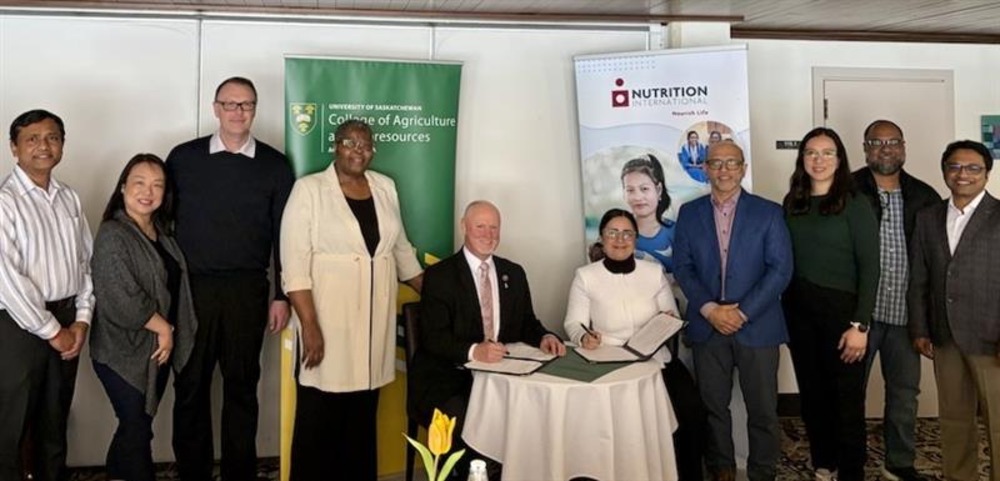
This MoU builds on a prior partnership between Nutrition International and the University of Saskatchewan established in 2018, which explored spray-fortified lentils and included product development, testing and market assessment studies in Bangladesh. These previous efforts laid the foundation for the current collaboration and reflect a continued commitment to innovation-driven solutions for global nutrition challenges.
“By combining our expertise in food science and processing with Nutrition International’s nutrition leadership, we can develop products that are scientifically rigorous, safe and ready for high-risk communities that need them most.
— Dr. Michael Nickerson, Saskatchewan Ministry of Agriculture Research Chair and Professor, University of Saskatchewan
“This MoU marks an important step forward in advancing evidence-based solutions that address malnutrition at scale,” said Joel Spicer, President and CEO, Nutrition International. “Together, we are combining Canada’s agricultural leadership with nutrition expertise to advance fortified lentils as a globally relevant innovation.”
“This partnership will allow us to translate agricultural research and the use of low-cost, sustainable disruptive technologies to address real-world solutions for global nutrition,” said Dr. Michael Nickerson, Saskatchewan Ministry of Agriculture Research Chair and Professor at the University of Saskatchewan. “By combining our expertise in food science and processing with Nutrition International’s nutrition leadership, we can develop products that are scientifically rigorous, safe and ready for high-risk communities that need them most.”
“This MoU marks an important step forward in advancing evidence-based solutions that address malnutrition at scale.
— Joel Spicer, President and CEO, Nutrition International
“We believe that strategic research is at the centre of finding adaptive solutions to the complex nutrition and public health problems of populations today,” noted Dr. Mandana Arabi, Vice President of Research & Development and Chief Technical Advisor at Nutrition International. “Together with centres of excellence in research and development in Canada such as the University of Saskatchewan, we intend to produce a fortified lentil product that can address multiple nutrient deficiencies using a healthy and sustainable food vehicle.”
Data shows that undernutrition and micronutrient deficiencies reduce productivity and economic output, costing the global economy an estimated US $761B or 0.9% of GDP annually, underscoring the need for effective nutrition interventions. Iron deficiency alone affects an estimated two billion people worldwide, including approximately 1.2 billion with iron-deficiency anaemia. Its consequences extend beyond individual health, impairing children’s cognitive development and school performance, and increasing health risks for women of reproductive age.
“Together with centres of excellence in research and development in Canada… we intend to produce a fortified lentil product that can address multiple nutrient deficiencies using a healthy and sustainable food vehicle.
— Dr. Mandana Arabi, Vice President of Research and Development and Chief Technical Advisor, Nutrition International
Fortified lentils are emerging as a highly promising solution. Naturally rich in protein and fibre, affordable and widely accepted across cultures, they are already a staple in the diets of millions. As Canada’s top agricultural export, lentils are shipped from Canadian farms to over 80 countries each year, making them a practical, scalable vehicle for fortifying diets with essential micronutrients. They are also environmentally sustainable, requiring relatively little water and producing a low carbon footprint, supporting global goals for climate-smart agriculture.
Previous research, conducted by Nutrition International, the University of Saskatchewan and other partners, has established a solid foundation in lentil fortification. Building on this collaborative work, emerging technologies for fortification offer opportunities for improved nutrient retention and greater adaptability to country-specific contexts.
Under the MoU, the two organizations will:
Together, Nutrition International and the University of Saskatchewan aim to position Canada at the forefront of lentil research, strengthening global nutrition outcomes while reinforcing Canada’s role as a leader in sustainable agriculture and food innovation.


Related News